
WELCOME TO MY TECHONOMICS BLOG
A blog designed in order to discuss about one of the major yet not so visible economic contemporary issue in India;
“LOW LEVEL OF TECHNOLOGY IN INDIA”
So, join me on this journey to gain and pass some valid information on this topic.
All your views and comments are valuable!
What is low-level technology?
Low technology or low tech , is just technology, often of a traditional or non-mechanical type, like those of crafts and tools that fall prior to the Industrial Revolution. Low technology can typically be achieved with a minimum of capital investment by an individual or small group of individuals. Also, the intellect of the practice can be completely decoded by a single individual, free from increasing specialization and compartmentalization. Low-tech techniques and designs may fall useless due to changing Socio-economic conditions or priorities which INDIA as a developing country is going through at this hour.
Examples:

- Weaving produced on non-automated looms, and basketry.
- Hand wood-working, joinery, coopering, and carpentry.
- Folk music played on acoustic instruments. https://en.wikipedia.org/wiki/Low_technology
Types of low technology:
- Retro technology
- DIY
- Handmade
- Traditional items
- Slow movement
- Passive design
- Innovation
https://simplicable.com/new/low-technology
Though low level technology may sound really appealing and not be shown as a problem as these are the general and creative things which make a country unique and raw to its roots it is usually not that true. with persistent low level technology a country’s development can become stagnant and that is not what INDIA as a country is seeking for itself.
The economic issue of the hour – Low level of Technology in India

New technologies are being given birth to every day all around the world. However, they are expensive and require people with a considerable amount of knowledge to apply them in order to increase the efficiency of production activities.
Any new technology majorly requires capital and trained and skilled personnel. Therefore, the lack of human capital and the invisibility of skilled labor are major hurdles in making technology add its best to the Indian economy.
Another aspect that caters this economic issues in India is that poor farmers cannot even purchase essential things like improved seeds, fertilizers, and machines like tractors, investors, etc. Further, most enterprises in India are micro or small. Hence, they cannot afford modern and more productive technologies.
https://www.toppr.com/guides/business-economics-cs/overview-of-indian-economy/development-issues-of-indian-economy/
For the same reason it has become important that India takes its growing technological activities seriously and welcome other technology from outside the borders and make provision for it to sustain.
Why India needs to take technology seriously
The article written by Nilanjan Banik, published in the economic times is the perfect fit for this topic as its heading says. A self interpretation of the article is as follows:
In the recent years, rising income inequality and jobless growth have been the topics of discussion and debate.
India’s average national income is $1,800 (about Rs 132,300) a year. However, 80% of Indians earn less than the average which is the very indicative factor that lack of education has gotten people the low income jobs and their lack of knowledge with respect to developing technology has also been affected and which cumulative affects the developing nature of the country as a whole.

With a widening income inequality, it may become impossible to sustain growth that India is going through at present and which is estimated to double in the future or just drop down if the country would not have the right mechanism to carter the technological advances it would see with rise in youth population and new ideas each person gives birth to. A country that neglects rising income inequality cannot sustain its long-term economic growth.
A paradigm shift is in the offing and technology is going to be a spoilsport, unless we make our workforce more skillful. India’s labor productivity economic output per hour of work is just 15% of US levels. The case of falling productivity is slowly marking its presence in India’s export growth. To add on to this even the lack of technological knowledge of many common Indian man can also affect the place that India takes among all the countries in national growth. It may be saved by its agricultural growth but at the same time this low level of technology in the same sector of India can backfire and nullify the success they have gained as a country.
In today’s era of big data analytics, machine and in depth learning, machines are increasingly over shadowing the human race . With technology changing so fast, no one knows where jobs of the future are going to rise from and what they will apparently be like.
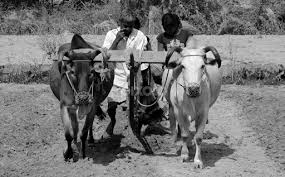
Primarily , agriculture, the mainstay of India’s livelihood, is not performing well. Indian farmers grow crops using more land, labor and animal inputs than technology. For a long time, output per hectare, a common measure of agriculture productivity, remained low in India. In potato farming, the productivity of an Indian farmer is less than half of that of the US, Germany and the Netherlands. In the case of rice, it is less than half of that of the US and Egypt. For wheat, it is less than half of that of the US, Germany and the Netherlands. In the case of rice, it is less than half of that of the US and Egypt. For wheat, it is less than half of that of Britain and Egypt.
Technology, the key to raising productivity, is here to stay. As much as 90% of increases in per capita income come from technological innovation. Now to find a strategy that will make technology inclusive is the task in hand that India has to fulfill.
Read the full content at:
//economictimes.indiatimes.com/articleshow/66307882.cms?from=mdr&utm_source=contentofinterest&utm_medium=text&utm_campaign=cppst
Does India need a HIGH TECHNOLOGY industry?
Despite some recent stumbles, most economic and demographic metrics favor India’s growth for several more years. Although the Indian economy is fairly broad based, it does suffer from some imbalances: the export sector is small, manufacturing is underdeveloped, and there is little high technology industry.
Examples:

- Telecom and networking
- Computing and automation
- Modern pharmaceuticals
- Commercial jet aircraft
- Advanced instrumentation like MRI machines.
Emerging high tech areas include genetic engineering and nanotechnology.
So does India really need a high technology driven industry?
YES!
Information and Communications Technology (ICT) infrastructure is a good example as it is clearly important to banking, stock market, and air and rail networks. Protecting this infrastructure from cyber-attack is hard enough for countries like the U.S., which dominates in this technology. It is much harder for India which does not have an ICT capability.
What about the economic value?
A vibrant internal industry can serve much of India’s needs and also be a major exporter, creating thousands of high-end jobs. Another reason to develop a high tech industry is that about half of GDP growth in developed countries comes from the high technology sector and India too will have to soon seek its growth from this sector since the current growth engines will inevitably slow. And finally a high tech industry is that which promotes national unity and cohesiveness. High tech companies are global and demand highly educated work forces, all of which reinforce ownership and nationhood. Research from the Kaufmann Foundation in the U.S. has repeatedly found that locally owned industries have a strong effect on national stability. In India, the growth of Infosys and Wipro, albeit only technology service companies, has reinforced national identity and pride.
How can India build an internal high tech industry?

The country has many assets that can be harnessed to build such an industry, at least in sectors like ICT. India has strong core engineering skills in telecom design. In some manufacturing sectors like automobiles and pharmaceuticals, India is beginning to have global presence. All of this has deepened India’s management skills. Knowledge of English has been a big advantage for operating globally and has helped India’s success in engineering services. The IITs and NITs graduate a sizable number of undergraduate students in science and engineering. By statistics alone, the top 1-2 percent of the engineering student cohort who enter these institutions are extremely talented.
India needs a high technology industrial capability to create high-value jobs, sustain growth, protect its national security and build a vibrant society. Building a world class and globally competitive high technology industry is, no doubt, a huge task, but India has most of the ingredients for success. It just needs to add some vision, imagination and commitment.
https://casi.sas.upenn.edu/iit/paulraj
Contribution of adoption of high technology to fix six national issue
1. NETWORKED HEALTHCARE

Companies around the world are developing networked devices for continuous monitoring of health. Driven partly by individuals and partly by hospitals, new networked devices are set to bring about a revolution in the treatment of chronic diseases by catching them early. Hospitals, which were built for acute care, are keen to use this technology and extend their reach into the home. Networked devices will let hospitals monitor patients when they are away, and recommend interventions when a serious problem is imminent. Indian hospitals are already preparing for this change, which will be one of the biggest in the last century.
2.PROVIDING FOOD FOR EVERYBODY
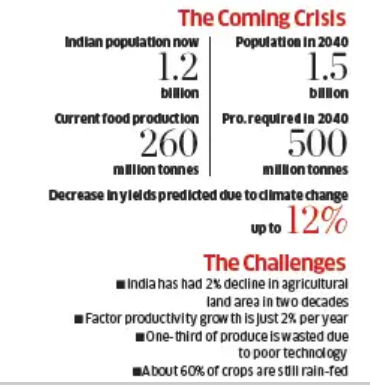
As our crop yields decline due to frequent extreme weather, genomics technologies can help increase yield by 20-30%. Genetic engineering can produce crops that can tolerate extreme temperatures. Extensive use of information technology can reduce water and fertiliser use in farms, and robots – called farmbots – can reduce back-breaking work. Smart technologies – driven by sensor networks – can fine tune our food supply chains and cut down waste significantly. There are a few potential game changers on the horizon. One of them is urban farming, involving techniques like hydroponics or aeroponics, which anchor plants in water or air and not in the soil. An extreme form of urban farming is the so-called vertical farm, which grows plants in controlled environments inside buildings.
3. CLEAN WATER FOR ALL
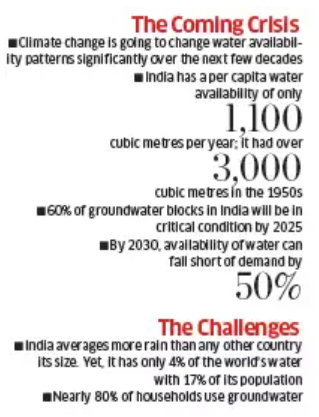
While all these things will reduce per capita water use substantially, they will not increase its availability. Desalination is being proposed as a good way to increase availability. This technique has some way to go before becoming environment friendly and energy efficient. The best method now seems to be storage, especially underground storage, either by recharging aquifers or underground dams. Underground water storage has its own problems like contamination and toxic metal leakage, but these are solvable. In the long run, it will work well along with desalination and water conservation.
4. GENERATING ENERGY AT LOW COSTS
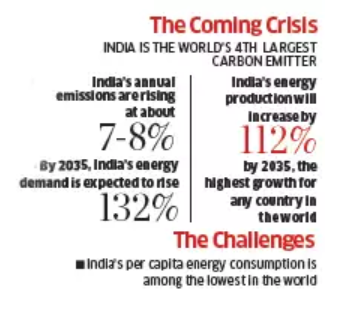
Solar energy will get better, and emerging grid storage technologies will let us use it at night, too. In the long-run, the only low-carbon energy source seems to be nuclear energy. Third and fourth generation nuclear energy technologies are safer and far more environment friendly than the current second generation ones. However, the number of nuclear plants around the world is predicted to decrease in future. By mid-century, perhaps, fusion energy would solve the energy problem forever.
5.GIVING QUALITY EDUCATION
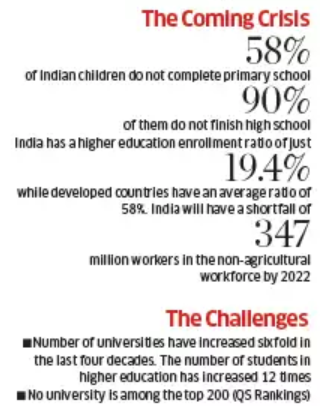
Massive open online courses (MOOCs) are only part of the story. In the near future, technology and attitudinal changes will force major universities to open new campuses — physical or virtual — around the world. Technology will allow universities to identify candidates remotely with as much accuracy as in a proctored examination. Students will learn from anywhere at any time, with highly-individualised curriculum and low costs. This will improve access to higher education. In some areas, motivated students can work around lack of adequate access to world-class institutions of higher learning.
6. MAKE OUR CITIES LIVABLE
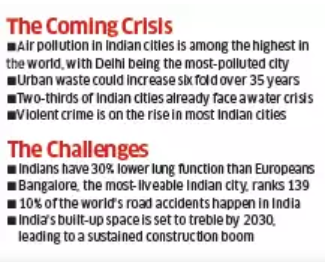
Although these work gradually over time, smart technologies will add an edge to managing cities. Sensor networks and analytics will combine to provide information about water usage, traffic patterns, accidents, fires and so on. They can be used even to improve education and healthcare or prevent crime. Over the years, smart technologies will make one big difference to the city: it will let us understand how our cities work.
Read full content on:
//economictimes.indiatimes.com/articleshow/31912712.cms?utm_source=contentofinterest&utm_medium=text&utm_campaign=cppst
INTERPRETATION AND CONCLUSION

India is going through many advancements and is also seeing some failures in many industries and fields. India as a nation is trying to cope to its best ability to tackle all the issues it is facing in order to fulfill the process of development it seeks to attain. Technology as a factor can be a game breaker or maker in the situation of current India. As the youth of this country it is our duty to raise our IQ rather than our voice in order to take calculative risks and help India develop to its fullest through the medium of technology which is the savior and trend of the hour.Hence, in order to turn the tables around from low level technology to a high level of technology we must improve our knowledge regarding all the techniques that technology and the digital world provides us in order to get India out of its cage bounded by a low level of technology.
 TECHONOMICS